Inner synchro-cities.
CDMX. L's one-year death anniversary. Dualities and interiors.

So I just returned from Mexico City (CDMX) last week.
Still mentally downloading all of the important messages I received from this visit—a cathartic, sometimes joyful offering of place, people, and culture to help soothe me in my grief. (And for me, joyful means deep convos with friend-strangers as broken as me; pouring over vibrant-bold graffiti walls; staring in awe at glorious-explosive, Surrealist art conjured by some of my sheroes [Kahlo, Varo, Carrington, Rahon, Horna]; walking for miles and stumbling upon every necessary moment of la vida cotidiana; strolling down calles bursting with ancient histories [Indigenous, Mexican, and Spanish]; and yes, laughing about the absurdity of life while wolfing down muy rico tacos, tortas, and tostadas). Note: Do not eat tostadas on a park bench. Lección aprendida.
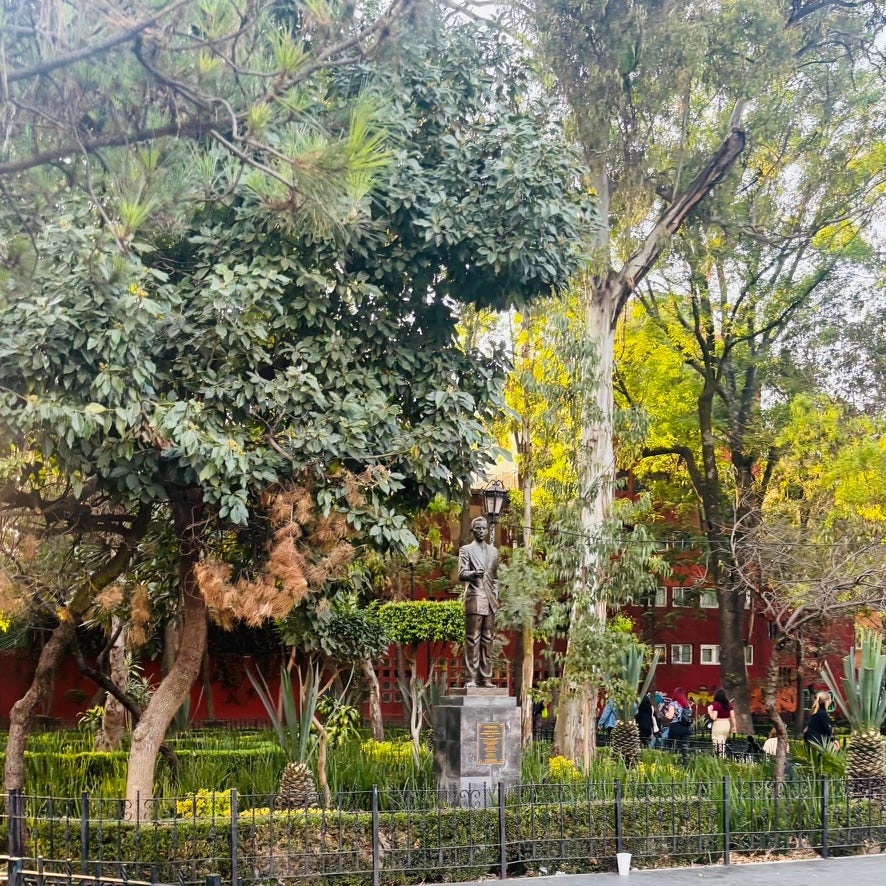
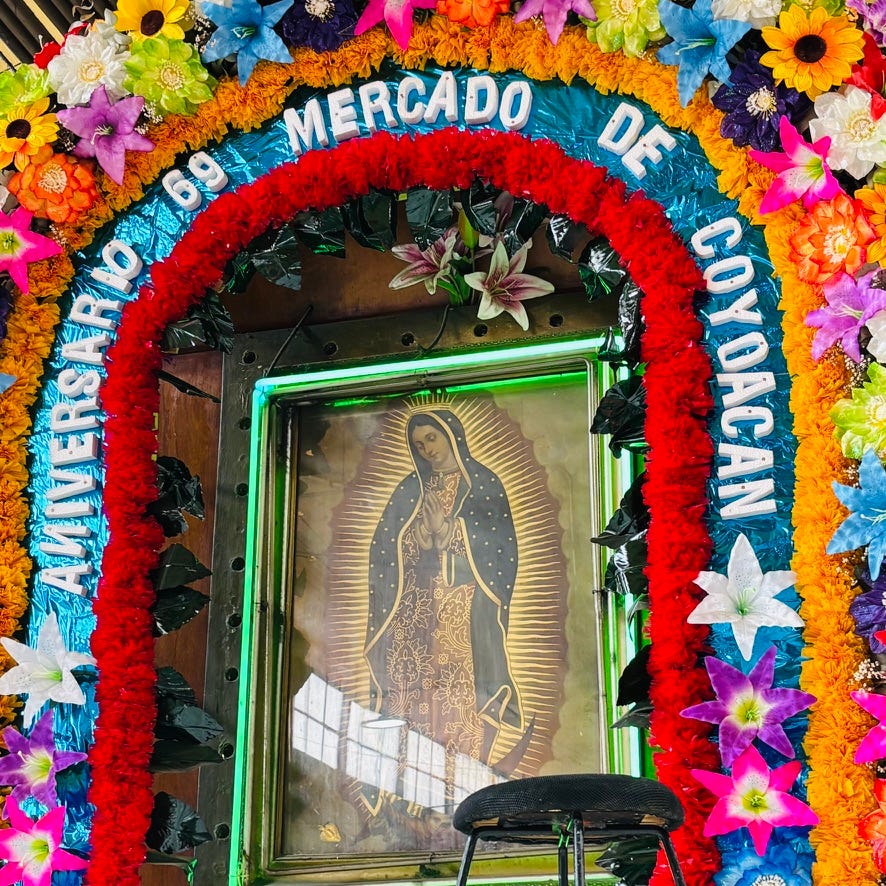
But let’s start with the fact that I almost ended up not going on this trip.
Two days prior to my departure, a rash of cartel violence erupted across Mexico. Everyone in the country was on high alert, airports were shut down. I was also struggling to keep my intentions clear: this trip was about marking the passage of time, one year since my soulmate, my best friend, and fellow astral traveler, Larry Sawyer, poet, passed away. But it was fast-becoming a “herding cats” situ in which I began feeling like someone leading a group tour (I’d asked some friends to join me, and many were sadly bowing out, unable to go).
I booked the trip in late December / early January. Both months were incredibly bleak: more sleepless nights, sobbing, eating Larry’s hair (yes, this is a thing—from NIH: “…eating hair can be due to intense, overwhelming grief, longing, or a, sometimes unconscious, desire to keep a piece of the deceased with them. While not typical, it is often tied to extreme emotional distress, where standard grieving rituals are insufficient to manage the pain”). Oh, and drinking (I fell off the wagon for a spell—I forgive me).


So I thought CDMX would be a suitable place to travel in winter because: (1) relatively short flight, and, (2) duh, SUN IN FEBRUARY, but also, Larry and I had always talked of returning to Mexico, as there was a loose connection. As poets (and sometime-artists), there was a rebellious and revolutionary spirit we admired, particularly around icons Frida Kahlo and Diego Rivera. We would often romanticize, talking about their relationship and the living arrangements at their joint home / studio, La Casa Azul. The freedom of sharing a communal-separate space to create—to have the right balance of solitude needed to work—sounded perfect. To be able to withdraw and retreat—spend time alone, write, perhaps edit video poems, watch experimental films, draw, take “lovers” (ha ha)—then come back together at a later time in the day or week, yes, that would’ve been delightful. In our first apartment together in Chicago, we were literally on top of each other (nice 💋, but also, as two restless spirits—cerebral, political, and passionate—we needed space, and we longed for this type of sprawling lair, which, sigh, we could never attain).
Also, CDMX seemed a solid choice for someone moving through grief, as it is literally the capital city of death culture, given its ties to it—viewing death not as an end, but as a natural continuation of life, often approaching it with humour, celebration, and intimacy. Deeply rooted in Indigenous (Aztec, Maya) and Catholic traditions, the culture is exemplified by Día de Muertos (Day of the Dead), where families create vibrant ofrendas (altars) to welcome back the souls of loved ones. In México, life is a dream and death is a return to a true state. Death is respected as part of the life cycle.
And so, La Casa Azul awaited me (and no coincidence that it is blue, re: Larry’s affiliation to the colour blue 🦋 - IYKYK).
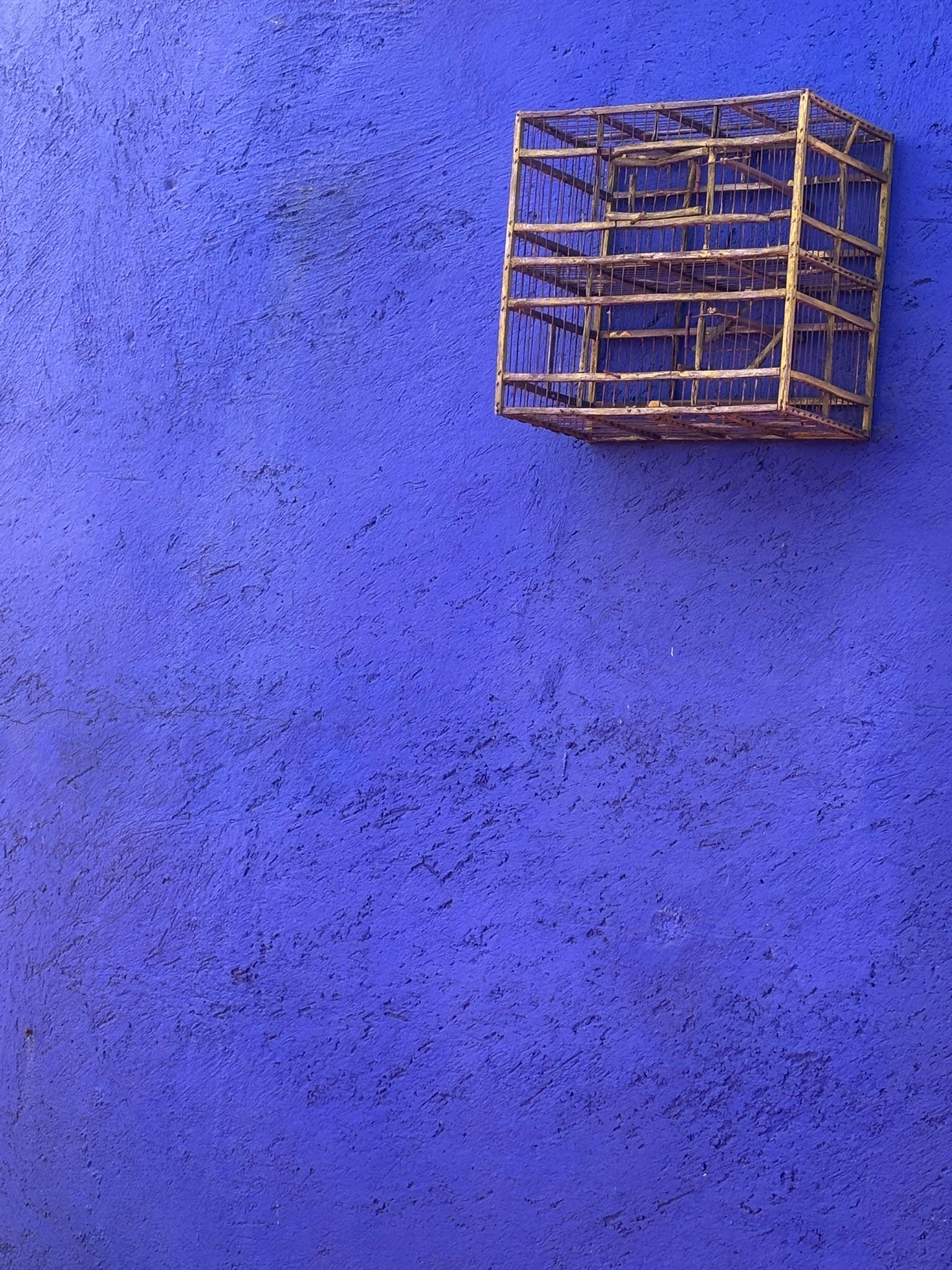
Finally, a quick side story which solidified my choice to travel alone, to spend Larry’s one-year death anniversary in a place I’d never been (if there was any remaining doubt): a week before the trip, I hastily signed up for a sound bath with 6-7 other women. After the session, the facilitator asked if anyone saw anything particularly moving or significant (sometimes lucid dreaming or visions happen during baths, as it is incredibly meditative). A woman next to me spoke up: “I don’t think this vision was for me, I think it was meant for someone else, but I saw a window and nothing but the colour blue.” I immediately turned to her and said: “I think that is for me. It will be the one-year anniversary of my partner’s death and I’m going to the Blue House / Casa Azul in Mexico City.” And soon after, another woman in the group piped up: “I just came back from Mexico City a week ago.” We all sat for a moment, deeply feeling connected. I felt supported. It was settled. I was going no matter if it was alone or meeting up with others (which I eventually did).
And my company was fitting by sheer happenstance: an old family friend and an old-new friend, both of whom were not new to the experience of great personal loss. One dear friend lost his father to AIDS as well as another family member, soon after, to suicide. The other friend lost both parents—one after another in close proximity—and not long after, his brother burned the family home down. So it is fair to say that I was in proper company—with two people I trusted enough, who felt connected to me through grief, as only others can who have experienced this type of trauma.
Teta J
And before I veer off into what would become a symbolic foundation for the entire trip (via Alice Rahon’s painting “The Inner City”), I’ll add that my trip to commemorate a death began with a death. Right as I was boarding my flight, I found out that my aunt, a remarkable woman, a professor who guided many young women through their engineering careers at a major US university, passed away. It was not lost on me that my frame of mind in the months prior—in tandem with my grief—was in pure rage mode for all suffering and grieving women in this moment in time. My soul—in chorus with many of my sisters worldwide—internally screaming, demanding a return to full matriarchy in the wake of endless war, genocide, rape, and abuse at the hands of the vampiric, capitalist patriarchs currently destroying our world.
My teta (aunt) Janie was near saintly. She came from Lithuania as a child (home of matriarchal anthropologist, Marija Gimbutas) poor and humble, working her way through school, studying hard to become the head of a linguistics department then shifting into a leadership role helping women succeed in a seemingly impentatrable, male-dominated profession. She was a graceful, gentle, and kind mother and a motherly figure to others—always encouraging and looking out for our family members, especially my dad, with whom she’d grown up closely. She worried for him constantly. (I told her repeatedly not to waste time on a narcissist-alcoholic, but she, in her devout way, always thought she could save him).
More importantly, she loved my writing, always checked in with me throughout the years (especially after Larry died). I felt her support lifting me hundreds of miles away—even though I rarely saw her. She was a beautiful, intelligent golden thread, part of the tapestry of strong women who held my family together. Her disappearance into another form, into a heavenly realm (her faith was strong), was perhaps a sign: enter through this gate, be continuously curious and brave, find the stories of women on the other side of your journey. And so, this was on my mind as I boarded the plane: a full intention to seek out the women who inspire me, some of the Surrealists who hailed from and dwelled in CDMX during a time where possibilities for women were few, but where a few women dared to live out their dream, expressing themselves on their terms.
🕊️ & 🦋
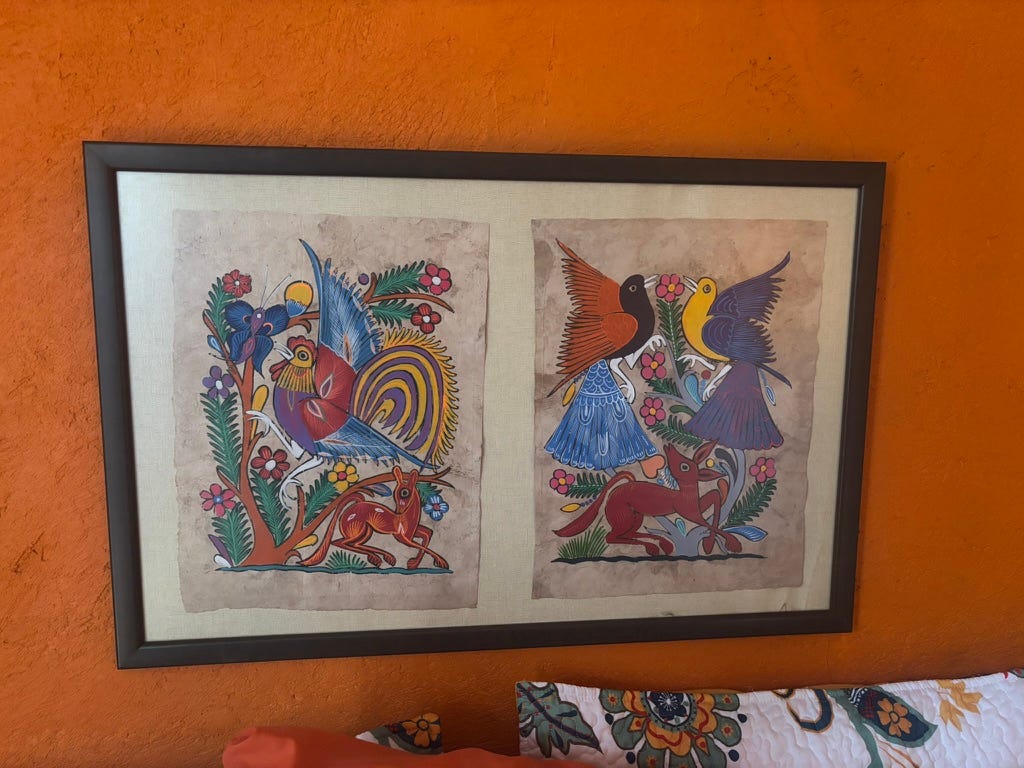
When I arrived, I felt slightly exhausted from travel (I left my tiny Toronto apartment at 4:30 am) but I was excited to start exploring. The kindly gay couple who owned the villa at which I was staying greeted me with warmth, relaying their condolences for my loss (I mentioned the purpose of my trip when I booked). When I walked into my room, I felt I was in the right place. An immediate sign surfaced from Larry: above the bed, a painting of a blue butterfly (the title of his upcoming poetry book in Canada) and two doves.
Larry and I had a special connection to mourning doves, and there were versions of them all around the neighbourhood, including live flocks of diminutive Inca doves in the surrounding trees, wistfully cooing each morning. My most recent tattoo, in fact, is of us [as doves] intertwined, with the title of his forthcoming, uncollected works in a delicate arch above: MY EYES WERE BOTH BIRDS. And to underscore this moment: the random song on my headphones when I arrived was “Coyote” by Joni Mitchell, a song Larry loved and namesake for the barrio I was staying in, Coyoacán (translation: coyote). A song about a couple, incidentally, who loved passionately but had a little trouble, in moments, connecting fully—a theme often running through our long-time courtship and partnership. Like Frida and Diego.
In Two
The day Larry died was February 28, 2025, around 6:30 EST. The day a mirror broke metaphorically (see below). We were split in two.
On this day a year later, I arose, joined my friend for breakfast and a long morning walk. We had tickets to the Frida Kahlo Museum (Casa Azul) right after lunch. We met up with our bubbly-yet-knowledgeable tour guide, who took us through the gardens and offered a magnificent look into both artists’ lives. She shared more about Frida’s childhood (Frida was a Gemini moon, btw), her illness and later, her accident. We learned more about how she overcame great odds to continue her art. A highlight of the tour: I stood before Frida’s ashes, moved by her spirit, remaining fully present, in awe of the lush and magical environs she’d built and with which she surrounded herself. Indeed, Frida is a shero of mine and the house did not disappoint. She was persistent, wildly curious and creative, a woman of great determination and conviction.
And her art, of course, resonates on many levels for many people.
For me, both The Two Fridas and The Love Embrace of the Universe, the Earth (Mexico), Myself, Diego and Señor Xólotl always especially struck me, deeply and personally.
The Two Fridas was painted after Diego and Frida divorced. She painted two entities of herself: the European side (her father was German-Hungarian) and the Mexican side (her mother’s). It was noted at the time that Diego still rejected the “European” side of her to some extent, yet deeply loving her talent and verve for life just the same. But the divorce was predicated on a betrayal that Frida deeply felt—she was disrespected time and again by a disloyal Diego. Both had poly or “ENM” tendencies, both sought out trysts and affairs, but Diego crossed trust boundaries—violated their pact as artists and individual beings in the world at-large. I found parallels to this in my own relationship, as Larry and I divorced at one point, for many reasons, however, like Frida and Diego, we romantically found our way back to one another. Another attraction to this painting and parallel I observed: Larry and I were astrologically linked—both Geminis (two sides of a whole, twins). In the past, I found myself melding often with his identity, and at present, I am reconciling a past I once had with him, now as an individual—a completely different person after his death.
I’d be remiss not to mention that, in Frida painting her two selves, she used a mirror to do such from her bed while convalescing. Larry often wrote / worked from behind a mirror of himself, metaphorically speaking: his work was often of an imaginary scape or scenario conjured deep from his marvellous imagination, and, when he was diagnosed with cancer in 2021, he immediately began a deep reflection of his life through his poetry (via the poems in The Blue Butterfly) in which mirror image / twin / split-self parallels crop up.
It was then that
poetry erupted around us,
covering our skin in the
black sands that
bloom at night on the
other side of your hallway mirror.

—Larry Sawyer
The Blue Butterfly
©2027 Guernica
I found it interesting that, back in August of 2025, I was unearthing so many of his poems at that time with mirror as a trope, the part of the summer I went to Ottawa-Montreal-St.John’s to not only read from my new chapbook at a poetry festival, but to find some solace, some truth in what art or nature would mirror back to me (and there were several instances of Larry revealing twin / couple / separation synchronicities). It was the first time (outside of visiting Seattle in June) I travelled as a solo “poet”. The new identity or self emerging. Also I find myself lately realizing, in my grief, that what I yearn for is someone to see me in the way that he saw me: a witness, yes, but a twin who can reflect back to me. I deeply miss our dialogue, the support of my other half. A friend I love so deep—one who knows so much of you that you become intertwined.
What strikes me personally about Frida’s painting The Love Embrace of the Universe, the Earth (Mexico), Myself, Diego and Señor Xólotl is the symbolism of maternity / matriarchy from the microcosmic to macrocosmic. The universe holding us, Mother Earth holding us, the central desire of Frida to be a mother (losing a child tragically, never being able to become a mother) her child-like qualities as compared to Diego, and yet unironically holding Diego like a child—she equally matched his bravado and unwavering strength. While I never personally desired motherhood, I deeply longed for a relationship with my own mother I could never have, up until her death only a year and a half before Larry’s. I lost my mother, a woman I’d always known through a lens of longing as I watched her enact her maternal qualities for others, but rarely for me. I loved my mother, even knew in some jagged, jealous way she loved me. She was proud of me, made me strong, but resented me (very Lithuanian / Russian!). This taught me to be my own mother, a mother to myself, and oddly, as of late, a mother figure to lost souls I’ve met along my way. Before Larry’s death and my mother’s, I caregave both of them (alongside my brother for my mother), had to assume a new role I was always/never prepared for, I shape-shifted into a pre- Baba Yaga-ish role, precursor to crone: a ragana (Lithuanian goddess / witch) which I am now fully embracing (menopause has fast-tracked me to this point). The layers of this painting resonate, as I came to it in this window of time: the veil of temporality, of death, so clear to me now in this new phase of my life.
Later in the day, post-museum, I observed a few hours / moments of silence alone in my room. I looked out of my window and saw a tiny heart in the sky. (Larry used to draw hearts on post-its and scraps of paper for me, stick them in my purse or bag, another endearing thing about him I really, really miss).


But memory, the trauma of the day he died, returned quickly like shadow passing through me. I cried a deeply cleansing cry, I felt every part of my being transported back to the moment I found him unresponsive. His essence permeated in a bright orange room, as the sun set against the wall. I collapsed on the floor and wailed uncontrollably. I needed the universe to hear me. A birth, perhaps, of a self emerging. Two worlds colliding, as indicated in the Alice Rahon painting (see below).
After collecting myself and heading off into the night to join my travel companions at dinner, I smiled as I looked up above our dining table: there was a mirror on the ceiling.
Inside Me A City
Tuesday 3/3: Decided to visit the Museo de Arte Moderno (MAM). I wanted to see all the Leonora Carringtons, Remedios Varos, Kati Hornas, and more Fridas.
It did not disappoint. The architecture of the museum itself, built in 1964, was a sleek wonder:
”…with an organic, irregular and asymmetrical geometry [the building] is made mainly of steel, glass and aluminum, and seeks to detach itself from historical references…it is rather embedded in the narrative of the International Style with clear intentions of transmitting a certain transparency and lightness...”1
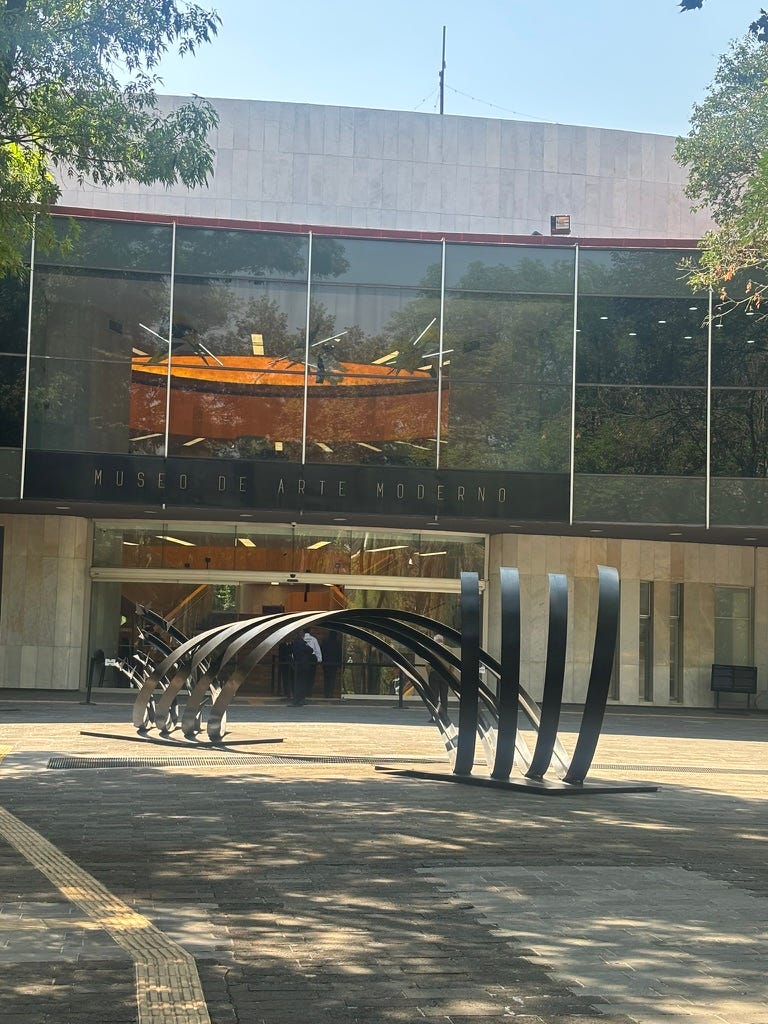
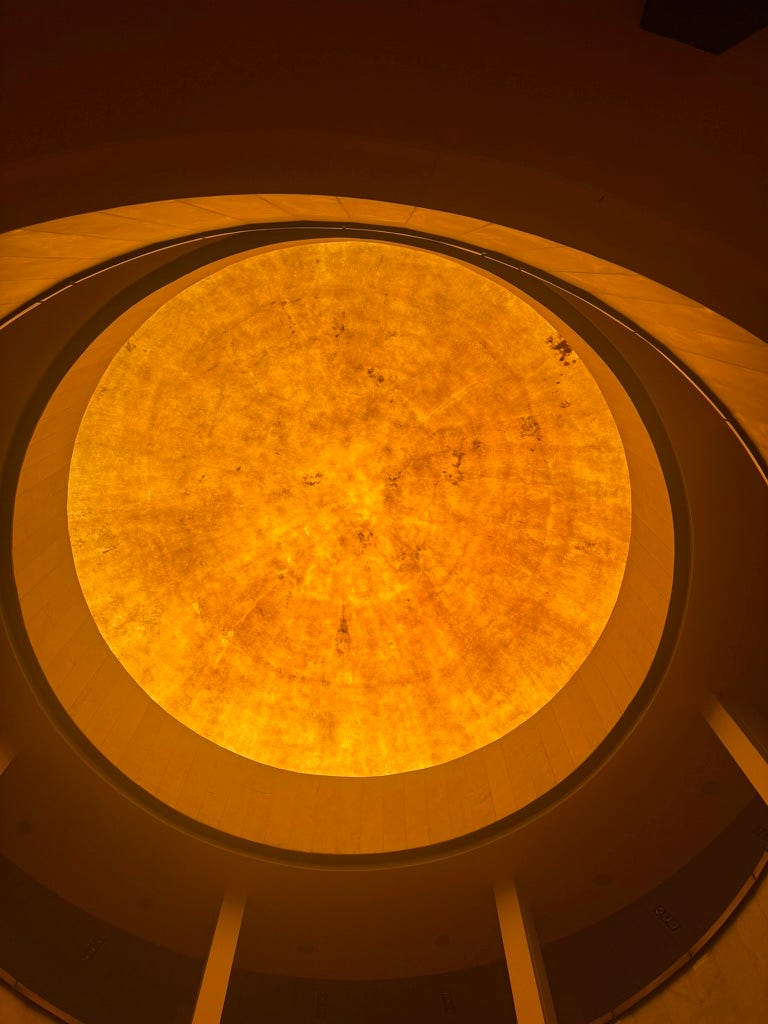
I gazed upon several astounding pieces, one after another encased in a glowing, golden light, a rotunda filled with Surrealist alchemy. My sheroes on full display, the intensity and intricacy of each painting and photograph I beheld with new eyes, though I’d seen a few of the Varo pieces up close at the National Museum of Mexican Art in Pilsen in Chicago many years prior.
And yet, one solitary painting stole my heart, captured it, and left me thinking for the rest of my journey: “The Inner City” by abstract expressionist / Surrealist, Alice Rahon.
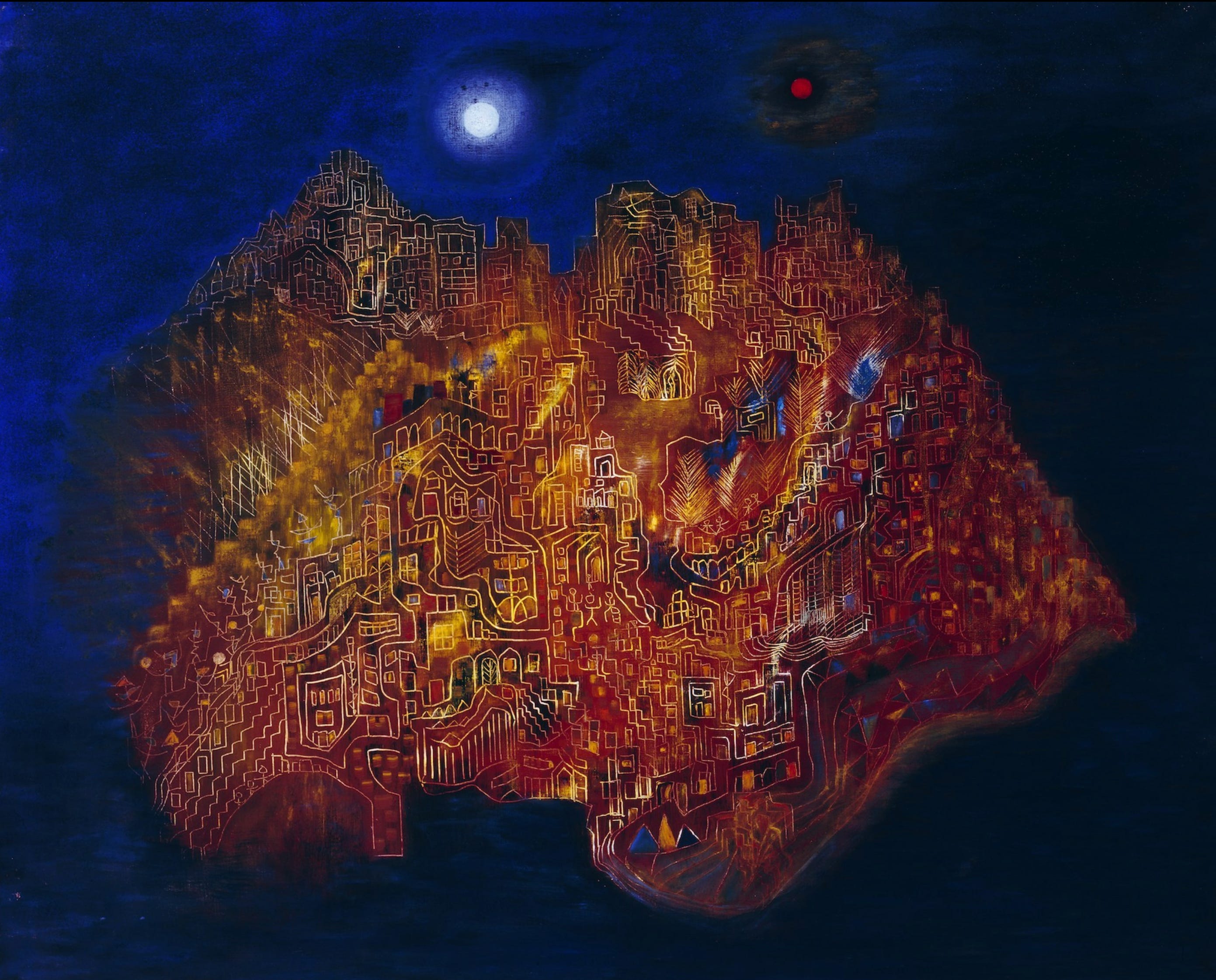
Rahon (another Gemini) was a French-born Mexican poet and artist who used the technique of sgraffito (scratching into canvas or metal) in her work. Like Frida, Rahon suffered a serious childhood accident which put her in casts and affected the rest of her life: one of the injuries was a fracture in the right hip, which forced her to recuperate lying down for long periods of time (like Frida). Rahon was invited, with two other artists / writers, to visit Mexico by Andre Breton and Frida. (Rahon was the first female to be published in Editions Surréalistes in Paris in 1936; as well, she and Frida had become fast friends).
One of Alice’s poetry books, À même la terre (On The Ground), featured a poem in which a woman “removes her face / safe from the traps of mirrors”. And another line, almost describing the painting (done years later): “Like the ember with blue down / in the armpit of the fire / that speaks in sparks”. (There has been ongoing parallels to the colours blue and orange throughout this last year, more on that later).
It also speaks of grief: “find me the words to console / my friend”.
The significance of the March 3, 2026 lunar eclipse (earlier that morning)—Blood Worm Moon, at 3:33 am PST—was not lost on me as I gazed upon this piece.
“Repeating threes in numerology are often interpreted as alignment with higher consciousness, creativity, and communication, as well as a balancing of mind, body, and spirit. In esoteric traditions, triads represent gateways: 3:33 appears as an archetypal threshold, initiating us into new soul narratives. The Blood Worm Moon in Virgo occurs near the South Node, and invites a release of outdated behaviour, structures that once created safety but now restrict growth. Eclipses collapse timelines: they reveal what was hidden and accelerate fate.”
The part of about collapsing timelines and new soul narratives? What could have been more accurate? Here I was, in CDMX to commemorate a death, this last year living like a shadow or ghost, communing with my soulmate from beyond through his poems, unsure of how to start anew? As I stood before the painting, from across decades, this fellow Gemini poet relayed a message, and I picked it up clearly via the matrix teletype: this map of an internal city of ancient ancestors, this map suspended in the universe, in the form of celestial lungs, a red sun and stark moon eye—all of it, was me.
Some dusty, earthy parameters etched into the outskirts, and so, so many rooms, several nuances of interior psycho-scapes. Where was I going? Where was I in this labyrinth of existence? I’ve always lived in cities, and my whole life, my external surroundings a concrete cage. But inside, there has been something natural emerging with constant, patient excavation, especially since Larry’s and my mother’s deaths. Living this last year in an inner city of myself, travelling to so many different cities (externally) on a grief mission, trying to make sense of the metaphorical, tangled box of wires that are now my neurotransmitters, trying to place myself in a new timeline. I have been surviving, not living, yet truly existing this last year. In this urgency, I am seeing the “reality” of life (and death) which I wrote about in one of my latest posts. (More Matrix-related parallels).
Alice Rahon, who kept only that part of her original name after Lewis Carroll’s Alice in Wonderland…Alice who fell down a rabbit hole, like me, in costume, dressed as little Alice on the Halloween after I’d been abused by a family member.
Rahon spoke across time to me. I realized my whole trip was to see this painting, a lookingglass.
So much more to say of it.


Soldiers
CDMX also delivered to me long, meditative, and meaningful discussions on identity, masking, uniforming / costuming, body dysmorphia, defending, covering up years of brokenness—even before the death tragedies of those closest to us. Witnessing self-erasure or destruction, as well as re-invention with other survivors in a vast and sprawling industrial-yet-vibrant city of revolutionary people—people deeply connected to their ancient roots, the earth, one that offers all the quiet complexity of tightly winding streets, homes to those who live among Inca doves and the mountains in the distance, Aztec ruins; those who thrive under the burning sun—created an internal shift for me. In a place that allows life and death to organically coalesce fluidly, this experience was exactly what I needed. All the gritty hardship against backdrops of deep spirituality and wild vegetation.
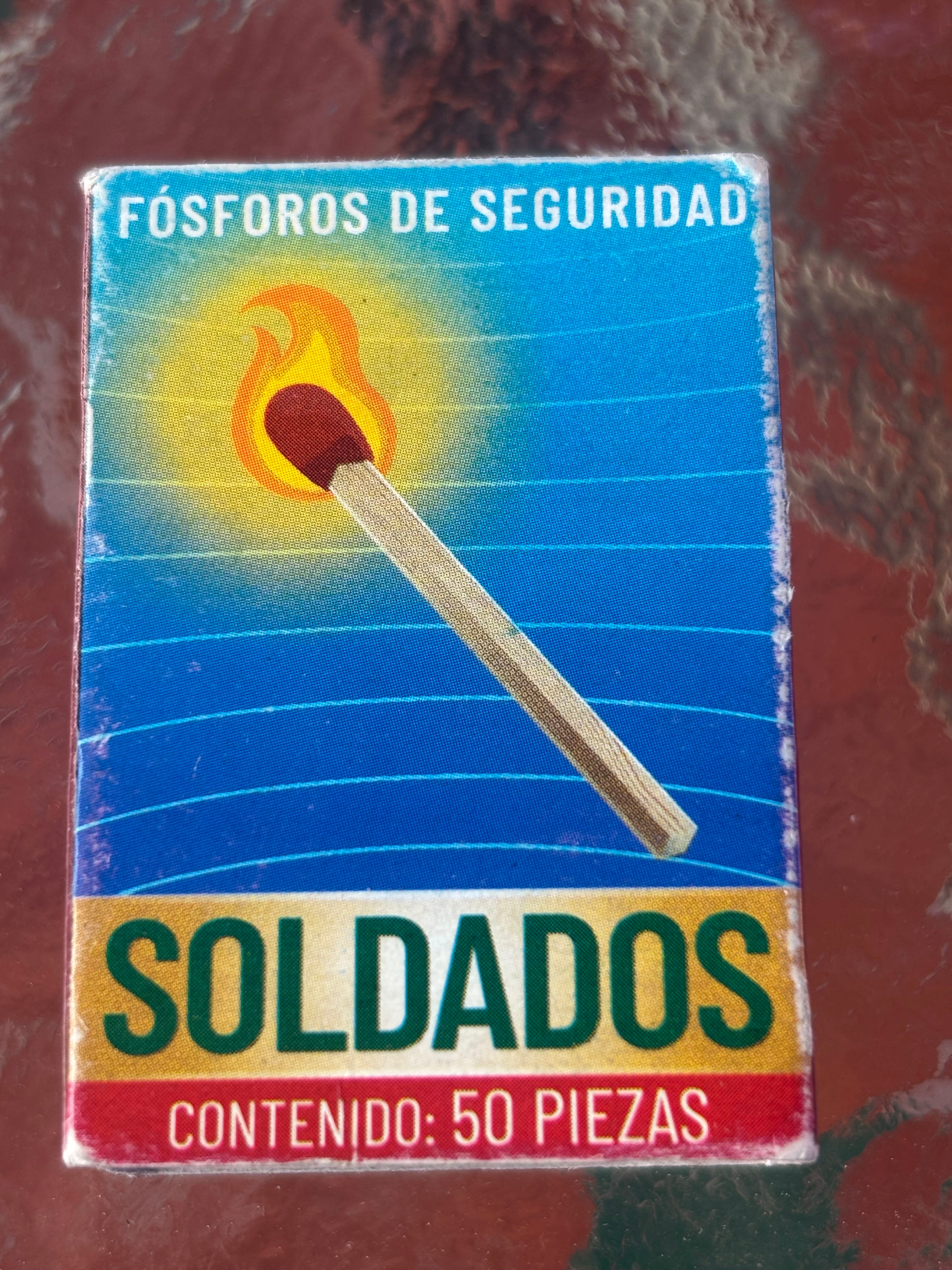
On the last day, one of my travel companions, someone who has become a dear friend, was reorganizing his travel pack. He couldn’t take his matches through security. We dumped out all the wooden sticks and I left them on the desk in my room, next to a generous tip for the housekeeper. I compressed the match case in my bag (as some may recall from a previous post, I was on a quest for matches / real experiences).
And on the cover of the matchbook:
https://architectuul.com/architecture/the-museum-of-modern-art-mexico-city
https://www.zonebooks.org/books/158-iconophages-a-history-of-ingesting-images
🩷🩷